The Data Center You’re Afraid of Doesn’t Exist Anymore
Viral videos show 15-year-old data centers—loud, diesel-choked relics. But modern facilities use liquid cooling, acoustic engineering, and behind-the-meter power. The tech has changed. The industry just hasn't bothered to explain it to the neighbors.
The images fueling data center opposition online are real — they're just old. Most viral photos and videos circulating in community Facebook groups and Nextdoor threads show legacy, air-cooled facilities from the 2000s and early 2010s: loud, power-hungry, and visually imposing. They're not what's actually being designed and permitted today.
This post breaks down three technological shifts changing what a modern data center looks, sounds, and operates like — liquid cooling, noise attenuation engineering, and behind-the-meter power — and makes the case that the industry has done almost nothing to explain these changes to the communities living next to new projects. It closes with a direct challenge to developers: stop treating community engagement as a permitting formality, and start showing up with honesty and enforceable commitments before the opposition — and the outdated narrative — take hold.
There’s a video making the rounds. A massive industrial building, diesel generators rumbling, cooling towers roaring, lights blazing at 3 a.m. The caption reads: “This is what they want to build next to your neighborhood.”
It gets shared. It gets shared again. By the time it lands in a local community Facebook group, it’s been viewed a million times — and city council inboxes are already full.
The problem? That facility was built in 2009.
The data center industry has undergone one of the most dramatic technological transformations in the history of commercial infrastructure — and almost no one outside the industry knows it happened.
This isn’t a defense of every project or every developer. Communities have legitimate questions, and they deserve real answers. But the conversation can’t be built on a foundation of outdated fear. Because the noise, the heat, the power drain, the diesel fog — the things people are actually afraid of — are increasingly the problems that modern data center technology was specifically engineered to solve.
Let’s talk about what’s actually being built today.
Part One: The Technology Has Changed. The Narrative Hasn’t.
Why Social Media Keeps Showing You Yesterday’s Data Center
The viral videos aren’t wrong. They’re just old.
The images circulating on platforms like Facebook, Nextdoor, and X largely depict legacy hyperscale and colocation facilities built during the air-cooling era, roughly 2000 through 2015. These facilities were designed around a simple principle: move massive amounts of air through rows of servers to keep them from overheating. The result was loud, power-hungry, and thermally inefficient.
Those facilities exist. Many still operate. But they are not what is being designed and permitted today.
The problem is that fear travels faster than facts. A single photo of a 15-year-old industrial complex shared in a neighborhood group carries more weight than a white paper from an engineering firm. And developers, who have historically been terrible at public communication, have left that vacuum completely unfilled.
The result is a growing wave of community opposition based on a version of the industry that is rapidly becoming obsolete.
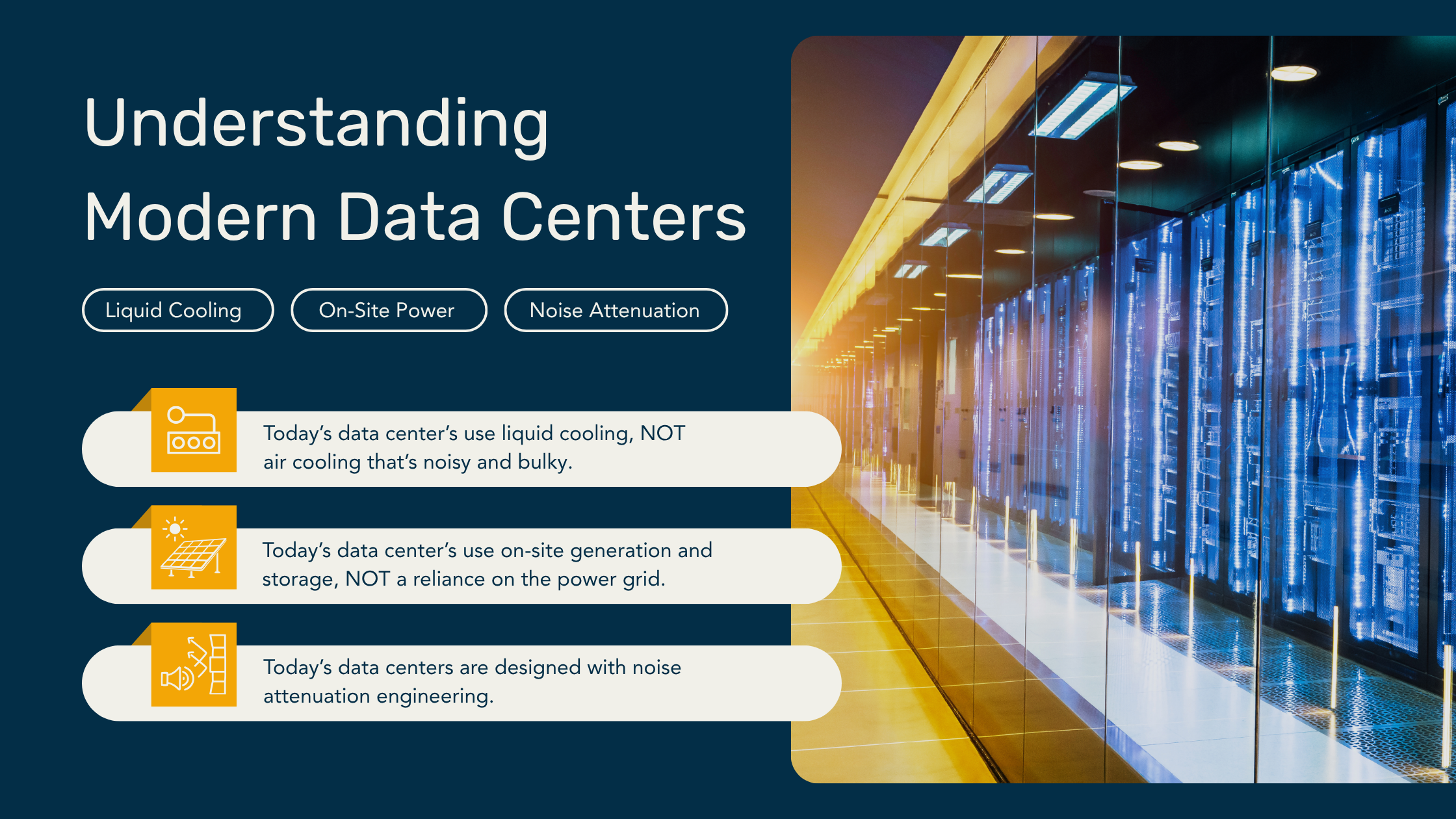
Understanding what’s actually changing requires a look at three specific technological shifts that are redefining what a modern data center looks, sounds, and operates like: liquid cooling, noise attenuation engineering, and behind-the-meter power.
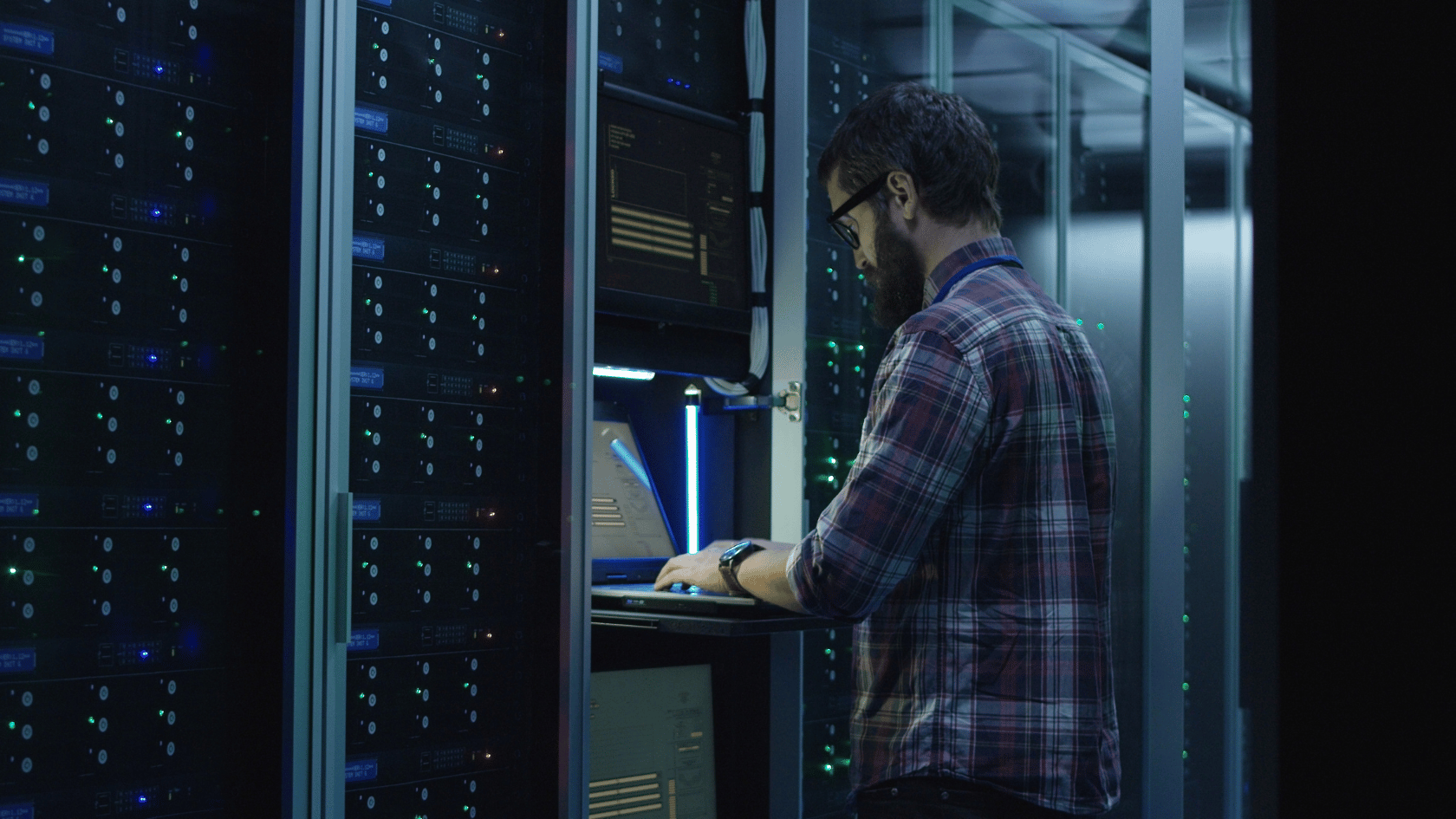
Today's data centers aren't the same as the traditional data center from year's ago.
Liquid Cooling — The Technology That Changes Everything
Here’s the thing about air cooling: air is a terrible conductor of heat.
For decades, data centers compensated by moving enormous volumes of air through raised floors, computer room air handlers (CRAHs), precision A/C units, and massive rooftop cooling towers. All of that mechanical infrastructure created two things communities noticed immediately: noise and visual bulk.
Liquid cooling changes the physics of the problem entirely.
Modern liquid cooling whether direct-to-chip, immersion cooling, or rear-door heat exchangers delivers coolant directly to the heat source rather than relying on air as an intermediary. Water (or dielectric fluid, in the case of immersion systems) is orders of magnitude more efficient at transferring heat than air. That means facilities can reject far more heat with far less mechanical infrastructure.
The practical implications for communities are significant:
Fewer cooling towers. In many modern liquid-cooled designs, the massive evaporative cooling towers that dominated the skyline of older facilities are eliminated entirely in favor of compact dry coolers or heat exchangers.
Less mechanical noise. The roaring of air handlers, precision cooling units, and tower fans was one of the most common complaints near legacy facilities. Liquid-cooled systems operate with dramatically reduced mechanical noise because you’re moving fluid through pipes, not forcing air through enormous fans at high velocity.
Higher density, smaller footprint. Because liquid cooling is so much more efficient, the same compute capacity can be packed into a significantly smaller physical footprint. Facilities that once required sprawling campus-style layouts for smaller output can now be built more compactly, reducing visual impact on surrounding areas with the same output.
The AI computing boom has actually accelerated this transition. The GPU clusters powering large language models and AI training workloads generate heat densities that air cooling simply cannot manage at scale. Liquid cooling isn’t a future option for modern AI data centers, it’s an operational necessity. Which means the new generation of facilities being built right now, in communities across the country, are liquid-cooled by default.
The data center your neighbor is protesting is almost certainly not the one in that Facebook video.
Noise Attenuation — The Engineering Most People Never Hear About
Ask a data center engineer about noise and you’ll get a detailed, nuanced answer.
Ask a community activist about noise and you’ll get a video of diesel generators during a load test.
Both are real. Neither is the full picture.
Modern data center development now routinely incorporates sophisticated noise attenuation engineering at the design stage, not as an afterthought, but as a core specification. This includes:
Acoustic barriers and berms. Engineered earthworks and solid barrier walls can reduce noise transmission by 15 to 25 decibels or more, depending on design. When sited correctly, they functionally eliminate the noise footprint for neighboring properties.
Enclosure design and equipment selection. Cooling equipment, backup generators, and electrical infrastructure are increasingly specified with noise ratings as a primary criterion. Manufacturers have responded with equipment lines specifically designed for urban and suburban adjacent deployments.
Vibration isolation. Low-frequency vibration, the hum that can travel through ground and building structures, is addressed through vibration isolation pads, floating floors, and spring-mounted equipment that decouples mechanical systems from the structure.
Architectural integration. The era of the bare metal box is giving way to facilities that are designed to blend with their surroundings; landscaping buffers, architectural facade treatments, and site layouts that orient noisier mechanical equipment away from residential boundaries.
None of this means noise is a non-issue. It means it’s an engineering problem, one that the industry has increasingly effective tools to solve. The question isn’t whether a data center will be loud. The question is whether the developer is being held accountable for specific, measurable noise standards as a condition of approval.
And that’s a question communities can and should be asking at permitting hearings, not just sharing videos about concerns using legacy facilities.
Behind-the-Meter Power — The Grid Concern Reframed
This is the issue that hits hardest in community opposition, and it’s the one where the conversation is most often oversimplified.
“Data centers are going to overload our grid.” It’s a reasonable fear, and it’s not entirely wrong but it obscures a much more complex reality.
Legacy data center development drew power entirely from the utility grid, at whatever scale the facility demanded. In regions with constrained transmission infrastructure, large new loads did, and sometimes still do, create real challenges for grid operators.
But the industry has responded with a category of solutions broadly called “behind-the-meter” power; on-site generation and storage assets that allow a data center to source a significant portion (or in some designs, all) of its power without drawing from the utility grid at all.
Behind-the-meter configurations in modern data center development can include:
On-site solar and battery storage. Large-scale photovoltaic installations paired with utility-scale battery systems allow facilities to generate and store renewable power, reducing or eliminating grid dependency during peak hours.
Natural gas or hydrogen fuel cells. Fuel cell technology provides low-emission baseload generation that can run continuously without the noise and air quality concerns of diesel combustion.
Co-located generation assets. Some developments are pairing data centers directly with new power generation; wind farms, solar installations, even small modular reactor (SMR) projects (coming soon) as co-located infrastructure that serves the facility without touching the distribution grid.
Demand response and load management. Modern data centers can participate in utility demand response programs, actually helping to stabilize the grid by curtailing non-critical load during peak demand events.
The honest conversation isn’t about whether data centers will hurt the grid. It’s about what specific power strategy a specific developer is committing to and whether those commitments are binding.
The Comparison Problem: Judging Tomorrow By Yesterday’s Standards
Here’s a thought experiment.
If you told someone in 1990 that you were going to build a cellular tower near their neighborhood, they might have imagined something like the broadcast towers they’d seen; massive steel lattice structures dominating the skyline, humming transformers, flashing warning lights.
What actually got built was a 50-foot monopole with a small equipment cabinet at the base, landscaped into a tree line.
Technology advanced. The mental model didn’t keep up.
The same gap exists today with data centers. The public mental model was formed by the large, noisy, power-hungry facilities of the 2000s and early 2010s. The reality of what’s being engineered and built in 2025 and beyond is often dramatically different.
Getting the mental model right isn’t about making communities more compliant. It’s about making communities more powerful; able to ask the right questions, demand the right commitments, and distinguish between a developer with a credible modern design and one cutting corners on an outdated template.
Part Two: A Direct Plea to the Data Center Industry
You’ve Built a Trust Deficit. Own It.
Let’s be direct: the data center industry created this problem.
Not through malice, but through a consistent pattern of behavior that prioritized speed and permitting efficiency over community relationship-building. Developers have routinely:
Submitted permit applications with minimal public notice
Engaged community members only when opposition had already organized
Dismissed concerns as technically uninformed rather than addressing them as legitimate
Made commitments at permitting hearings they never followed through on
Treated communication as a compliance exercise rather than a genuine obligation
Communities didn’t invent their suspicion from nothing. They learned it from experience with this industry and others. When a developer shows up with a 500-page environmental impact report and a two-week public comment window, communities reasonably conclude that the decision has already been made and their input is theater.
The industry cannot fix the social media narrative problem by funding better PR. It can only fix it by behaving differently, consistently, over time, in enough communities that the reputation changes at scale.
That starts with one thing: showing up before you have to.
Hold Town Halls - Real Ones, Not Compliance Theater
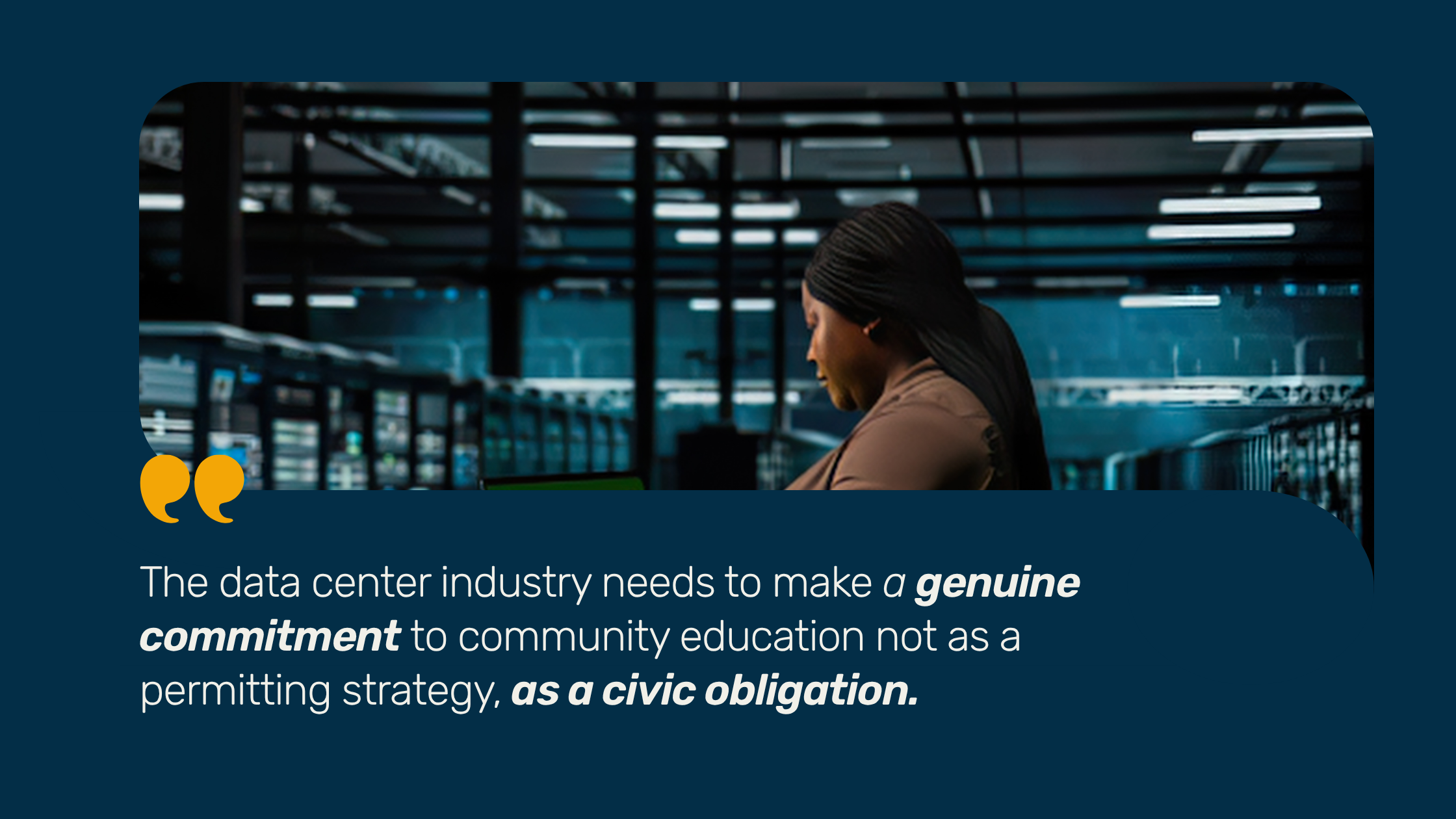
The data center industry needs to make a genuine commitment to community education and engagement not as a permitting strategy, but as a civic obligation.
Here is what that looks like in practice.
Engage before you file, not after. Before a single permit application is submitted, host community information sessions in the neighborhoods that will be adjacent to your facility. Bring your engineers, not just your communications team. Explain what you’re building, how it works, and what it won’t do.
Show, don’t just tell. Invite community members to tour an existing modern facility. Let them hear or more accurately, not hear a liquid-cooled data center operating at full capacity. Let them see a noise barrier in action. Let them ask the HVAC engineer directly what that cooling system sounds like at 2 a.m. Lived experience is more persuasive than any slide deck.
Acknowledge what’s real and what’s changed. Don’t ask communities to pretend the older generation of facilities doesn’t exist. Acknowledge that those concerns are valid for that technology, then explain, specifically and technically, how your design addresses each one. The contrast is your strongest argument.
Answer the hard questions honestly. Communities deserve honest answers about water consumption, peak noise levels at property boundaries, grid capacity impacts during construction, the facility’s long-term evolution as technology changes, and what remediation commitments exist if agreed-upon standards aren’t met.
Create binding, enforceable commitments. A town hall that ends with “we’ll do our best on noise” is worse than useless, it’s a credibility withdrawal. If you’re committing to a maximum decibel level at a property boundary, put it in a development agreement with a third-party enforcement mechanism. Make it a permit condition. Communities have been burned by verbal assurances.
Include the negative. This is the hardest ask, and the most important one. Tell communities what the real impacts will be; construction traffic, temporary generator testing, water use, visual presence. Developers who come in with an honest accounting of trade-offs, rather than a pure sales pitch, build the kind of trust that carries a project through opposition.
The Opportunity You’re Leaving on the Table
Here’s what the data center industry often fails to see: community opposition isn’t just a problem to be managed. It’s an opportunity being squandered.
Data centers, done right, are genuinely good neighbors. They bring:
Property tax revenue that funds schools, roads, and public services without placing proportional demand on those services
High-wage construction employment for local trades
Permanent technical employment for a small but meaningful workforce
Infrastructure investment in fiber, power, and roads that benefits the broader community
Economic multiplier effects that attract complementary businesses
These aren’t talking points. They’re real, documented economic impacts in communities across the country from Northern Virginia to Central Iowa to the outskirts of Phoenix.
But communities can’t weigh those benefits against their concerns if no one is presenting both sides of the ledger honestly.
The industry has a remarkable story to tell about how far the technology has come. The problem is it keeps waiting for someone else to tell it, in the right venue, to the right people, at the right time.
That venue is a community meeting room on a Tuesday night.
That right people are the neighbors who are currently signing a petition.
And the right time was before the permit application but the second-best time is right now.
Conclusion: The Conversation We Actually Need to Have
The data center opposition sweeping American communities isn’t irrational. It’s a reasonable response to incomplete information in an environment where trust is low and the stakes feel high.
The technology has moved. The narrative hasn’t. And the industry that built the technology has done almost nothing to close that gap.
Liquid cooling, acoustic engineering, and behind-the-meter power aren’t silver bullets. They don’t make every project right for every community. But they represent a genuine and significant transformation in what data centers actually are and communities deserve to understand that transformation when they’re making decisions about their own neighborhoods.
More than that, they deserve developers who show up with honesty, humility, and a willingness to have a hard conversation before they need a permit not because it’s good strategy, but because it’s the right way to build.
The data center you’re afraid of may not exist anymore.
But you’d only know that if someone bothered to tell you.
Have questions about data center development in your community? Share this post with your local planning board, city council representative, or neighborhood association. The more informed the conversation, the better the outcomes — for communities and for the industry.
Ready to Put These Ideas into Action?
Don't let operational challenges slow down your facility. Our team has helped data centers just like yours reduce downtime by 58% and catch problems before they happen.


.png)