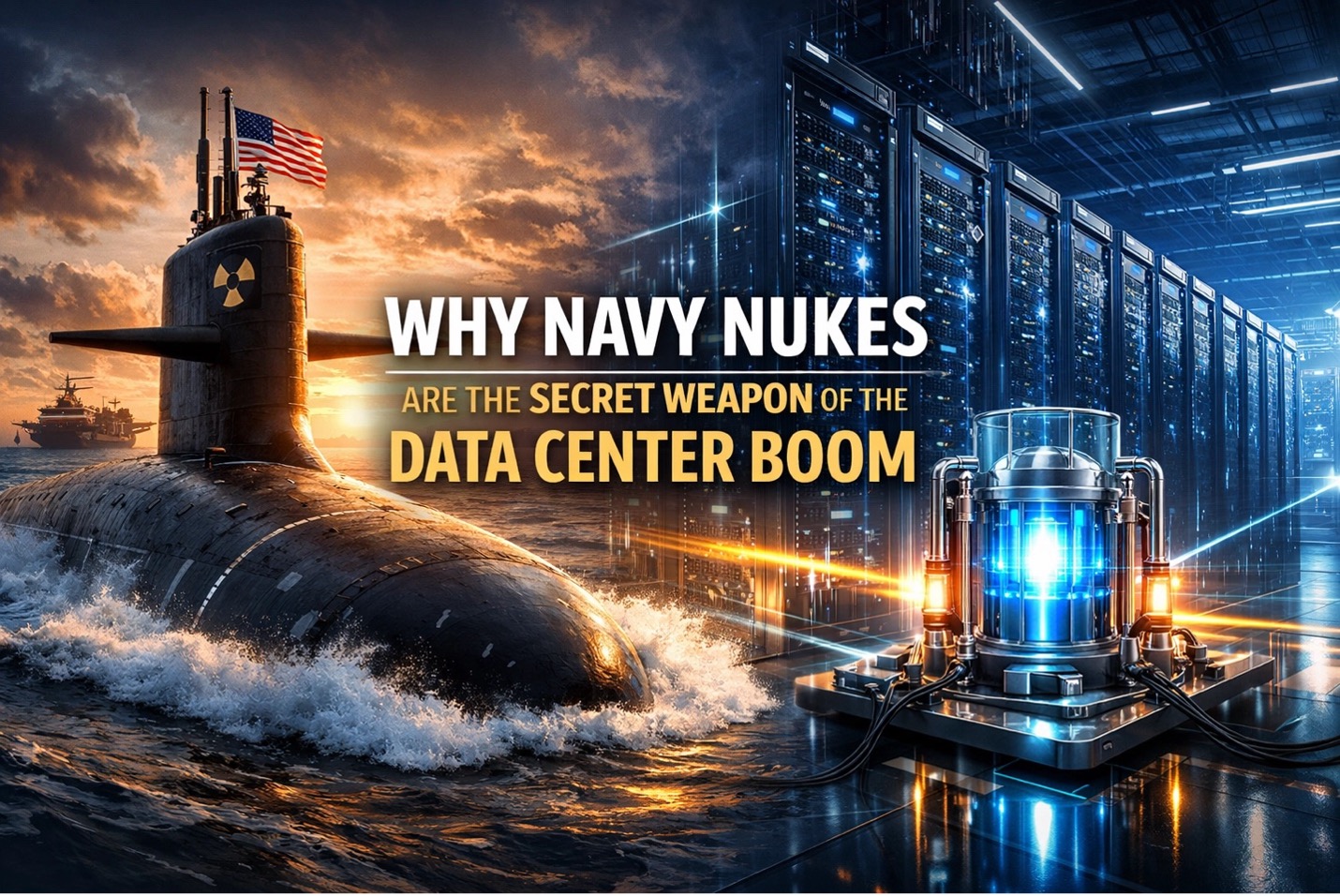
Why Navy Nukes Are the Secret Weapon of the Data Center Boom
Why Navy Nuclear veterans are becoming essential to the data center boom—bringing mission-critical discipline, operational excellence, and nuclear expertise to solve power, scale, and reliability challenges.
As AI accelerates data center growth, the industry faces two urgent challenges: operational reliability and access to massive, consistent power. This article explores why veterans of the U.S. Navy Nuclear Propulsion Program are uniquely equipped to solve both. Trained in zero-defect environments, Navy Nukes bring unmatched procedural discipline, systems thinking, and incident-response expertise to hyperscale data centers. At the same time, their nuclear experience positions them to bridge data center operations with the resurgence of commercial nuclear power, including SMRs and repurposed naval reactors. As data centers and nuclear energy converge, Navy Nukes are emerging as the critical talent pipeline enabling safe, scalable, mission-critical infrastructure for the future.
The data center industry has a problem. Actually, it has two problems: and veterans of the U.S. Navy Nuclear Propulsion Program are uniquely positioned to solve both of them.
While hyperscalers scramble to build capacity for AI workloads and the talent market tightens, there's a pipeline of highly trained professionals who've spent years operating the most mission-critical systems imaginable. They've managed nuclear reactors on submarines and aircraft carriers, where downtime isn't an option and a single procedural mistake can have catastrophic consequences.
These aren't just good candidates. They're the best candidates: and the market is finally catching on.
The Navy Nuke Advantage: Mission Critical by Design
The Navy Nuclear Propulsion Program isn't just rigorous: it's legendary. Acceptance rates hover around 3%, and the training pipeline spans 18-24 months of intensive technical and operational instruction. By the time these operators complete their service, they've logged thousands of hours managing complex systems under conditions most facility managers will never experience.
Here's what they bring to the table:
Procedural Discipline That's Non-Negotiable
Navy Nukes operate under a zero-defect culture. Every action follows documented procedures. Every valve position is verified. Every system interaction is logged. This isn't corporate lip service to best practices: it's how they've operated for decades without a single reactor incident in the fleet.
Data centers demand the same discipline. When you're managing uptime SLAs of 99.995% or higher, procedural compliance isn't optional. Navy Nukes don't just understand this: they've lived it.
High-Pressure Decision Making
Operating a nuclear reactor in a submerged submarine or during flight operations on a carrier deck means making critical decisions with incomplete information, time pressure, and zero margin for error. These professionals are trained to maintain composure, follow protocols, and execute flawlessly when it matters most.
Sound familiar? That's exactly what's required during a data center incident when customers are offline and every minute costs thousands of dollars.
Systems Thinking and Troubleshooting
Navy reactor operators don't just know their immediate systems: they understand how every component interacts across the entire propulsion plant. They can diagnose problems systematically, trace root causes through complex failure chains, and predict cascading effects before they happen.
This holistic view translates directly to data center operations, where electrical, mechanical, and IT systems intersect in increasingly complex ways.
Training and Knowledge Transfer
The Navy doesn't just train operators: it trains them to train others. Qualification programs are rigorous, documented, and continuously validated. Navy Nukes understand that tribal knowledge is a liability, not an asset. They build training programs that scale.
For data centers struggling with knowledge retention and standardization across global portfolios, this capability is invaluable.
The Data Center Power Crisis Is Real
Here's the other problem: data centers are running out of power.
AI workloads are fundamentally different from traditional compute. A single AI training cluster can consume 10-50 megawatts continuously. Hyperscale operators are planning facilities that require 100-300 megawatts of dedicated power: roughly equivalent to a small city.
Traditional grid infrastructure can't keep pace. Renewable energy, while important for sustainability goals, struggles with the consistency and density these facilities demand. Natural gas plants face regulatory headwinds and long permitting timelines.
The industry needs baseload power that's dense, reliable, carbon-free, and deployable at scale. That means nuclear energy: and it means a lot of it.
The Commercial Nuclear Renaissance Is Here
The commercial nuclear sector is experiencing a resurgence driven almost entirely by data center demand. Small modular reactors (SMRs), advanced reactor designs, and even repurposed naval reactors are all on the table.
Consider the CoreHeld Project: a proposal to repurpose decommissioned naval reactors from aircraft carriers like the USS Nimitz for commercial data center use. Two Westinghouse A4W reactors from a single carrier could generate 450-520 megawatts of continuous power. The cost? Roughly $1-4 million per megawatt: 50-80% cheaper than building new civilian nuclear facilities from scratch.
These aren't theoretical concepts. Major hyperscalers are already signing deals to co-locate facilities with nuclear plants. Microsoft has partnered to restart Three Mile Island's Unit 1. Amazon and Google are investing in SMR technology. Oracle is planning data centers powered by multiple small reactors.
The timeline is aggressive. The capital requirements are massive. And the operational expertise needed to bridge data center operations with nuclear power generation is specialized.
Very specialized.
Navy Nukes: Bridging Two Critical Worlds
This is where Navy Nuclear veterans become essential: not just valuable, but essential.
They're the only talent pool with deep operational experience in both domains. They understand data center mission criticality because they've managed systems where failure means loss of propulsion in hostile waters. They understand nuclear operations because they've run reactors for years under the most demanding conditions imaginable.
For Data Centers
Navy Nukes bring the operational maturity that hyperscale growth desperately needs. As facilities scale to unprecedented sizes and complexity levels increase with AI cooling requirements and power densities, the industry needs operators who don't just follow procedures: they build them, validate them, and train others to execute them flawlessly.
They understand incident response at a molecular level. They know how to conduct root cause analysis that actually finds root causes. They can design training programs that produce consistently qualified operators across global portfolios.
For Commercial Nuclear
As new reactor designs come online and decommissioned naval reactors transition to commercial use, the need for operators with nuclear experience becomes acute. Navy Nukes can bridge the gap between military and civilian nuclear operations, bringing operational discipline and procedural rigor to a commercial sector that's moving at startup speed.
They can help design operational frameworks, develop training curricula, and establish the safety culture that's non-negotiable in nuclear operations: whether military or commercial.
For the Industry
The convergence of data center growth and nuclear power expansion creates a unique moment. The professionals who can navigate both worlds simultaneously are rare. Navy Nuclear veterans represent the highest-quality talent pool available for this specific challenge.
Smart operators are already recruiting heavily from this community. The best candidates are being hired before they even separate from service. Competition for this talent will only intensify as more nuclear-powered data center projects move forward.
Building Systems That Scale
The data center boom isn't slowing down. The power demands aren't getting smaller. And the operational complexity isn't decreasing.
The question isn't whether Navy Nukes will play a critical role in this industry's future. They already are. The question is whether your organization is positioned to attract, retain, and scale the expertise they bring to the table.
Ready to Put These Ideas into Action?
Don't let operational challenges slow down your facility. Our team has helped data centers just like yours reduce downtime by 58% and catch problems before they happen.

.png)