What Gets Missed Between Construction Complete and IT Go-Live
Construction commissioning isn't operational readiness. This post breaks down the training, documentation, vendor, and testing gaps that commonly slip through before IT go-live — and how facility teams can catch them first.
Commissioning the building feels like the finish line, but it's really just the start of a new phase—and that phase is where risk hides for data centers. Between the last punch-list item and go-live, facility teams commonly miss things that commissioning never tested: staff who've never run the building under real conditions, documentation that doesn't match the field, vendors whose response times were assumed rather than confirmed, and systems that passed individually but were never tested together. These gaps don't show up on a construction checklist—they show up during the first real incident. This post breaks down the four zones facility teams need to validate before go-live, and how a structured readiness process catches what construction commissioning leaves behind.
What's the biggest gap between construction complete and IT go-live?
The most common gap we see after commissioning, is failure to test for operational readiness under real conditions. Your staff need to be trained, systems need to be run together, and processes need to be rehearsed. Construction commissioning may validate that equipment works, but it doesn't validate that people, procedures, and vendors can keep them working once load hits.
This distinction matters. A facility can pass every commissioning test and still fail its first real incident, because commissioning checks equipment performance, not organizational readiness. Data isn't kind to teams that skip this step: nearly 40% of organizations have suffered a major outage caused by human error over the past three years, and 85% of those incidents stem from staff failing to follow procedures or from flaws in the procedures themselves, according to Uptime Institute's Annual Outage Analysis. That’s a readiness gap, and if you aren’t careful during the handoff window between construction completion and go-live you’re putting your data center at risk.
Don’t Overlook Handover Documentation
Documentation that’s shared during the handover process isn’t a paperwork exercise—it’s an operational tool. Even if your building is an as-built, you shouldn’t rely on it being exact in the field, and sequence of operations (SOO) documents don’t always get updated after the last change order.
These are the most predictable patterns we see:
As-builts vs. reality—drawings don’t always reflect last-minute field changes made during construction. They’re really for design.
Sequence of operations—the logic that tells operators how systems are supposed to respond are often outdated by the time of go-live.
Spare parts and BOM data—critical spares specified in design aren’t verified against what's been installed.
Vendor warranty and service documentation—not centralized in one place where operations can find it.
We know this isn’t anything crazy from what you already know. But it's unglamorous, detail-heavy work that determines whether a technician can troubleshoot a 2 a.m. alarm confidently or start at zero. Steadfast Operations identifies these kinds of gaps early on by performing a structured assessment before mistakes turn into incidents.
Are vendors and the supply chain actually ready to support Day One?
Vendor readiness should never be assumed and should always be verified. Contracts get signed, but response-time commitments, escalation paths, and spare-parts availability don’t always get tested until a facility needs them. Teams find out a vendor isn't ready the same way they find out a fire alarm doesn't work: during the event itself.
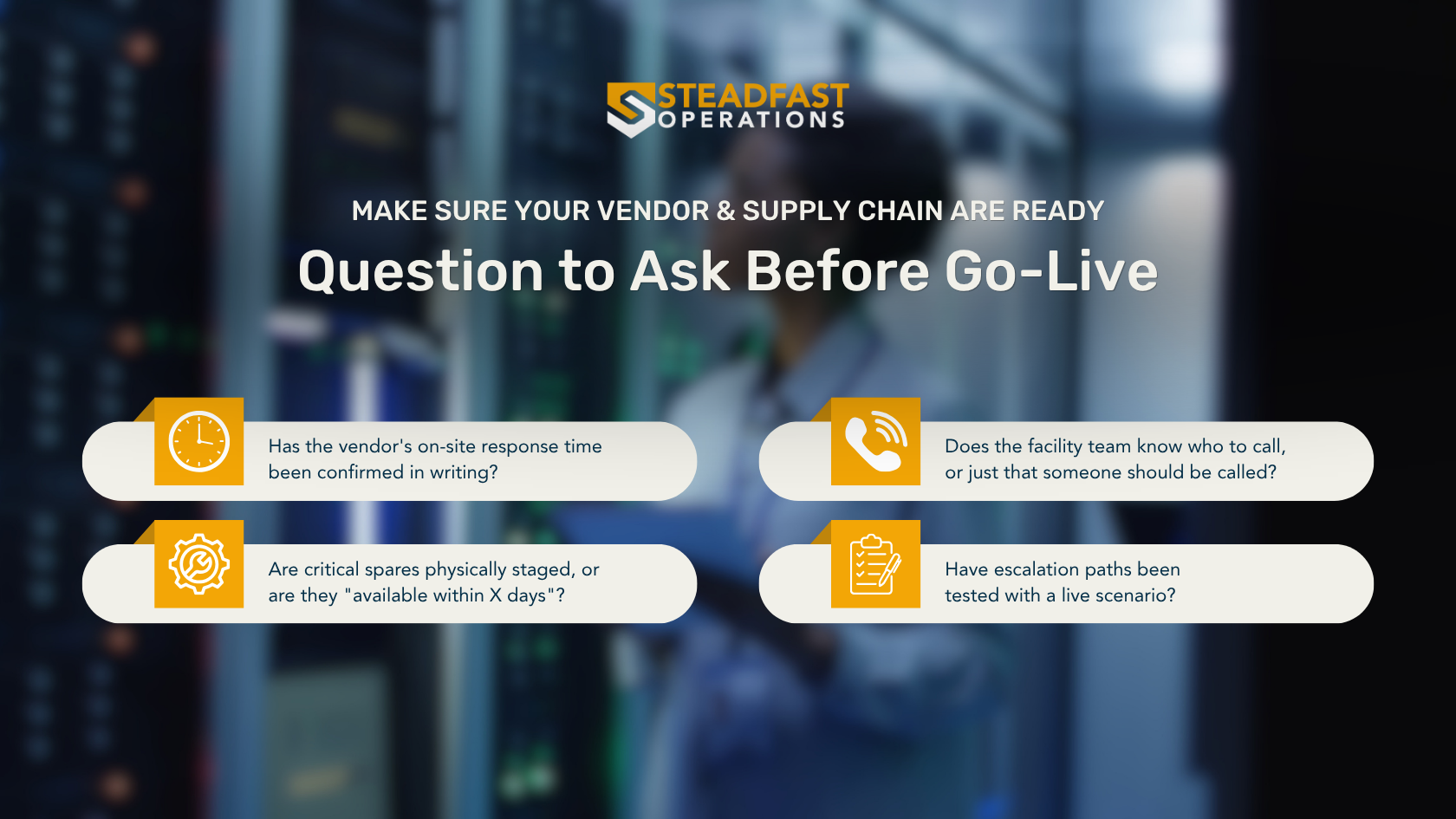
Ask these questions before go-live to ensure operational readiness.
Questions we suggest you ask before go-live:
Has the vendor's on-site response time been confirmed in writing?
Are critical spares physically staged, or are they "available within X days"?
Does the facility team know who to call, or just that someone should be called?
Have escalation paths been tested with a live scenario?
Supply chain readiness is one of the four zones Steadfast validates as part of Catapult™, our startup and operation readiness program
Have systems been tested together, or just individually?
Individual system commissioning doesn’t reveal how systems behave under combined, real-world load. That's where go-live problems tend to surface. A generator that passed its load bank test and a BMS that passed its point-to-point check can still fail to coordinate correctly the first time they're exercised together under a utility event.
Integrated testing—sometimes called integrated systems testing (IST)—is where you can identify these interaction failures. Skipping or rushing through this step is one of the most expensive shortcuts you can take. The cost of finding a coordination failure during a rehearsed test is a schedule delay, but the cost of finding it during a live event is an outage.
How can facility teams close this gap before go-live?
Closing the gap requires validating readiness across four zones—people, process, systems, and support. With a structured checklist and a real-time dashboard, you can determine operational readiness.
Here’s what this looks like in practice:
People—Thoroughly train your staff and walk them through real scenarios.
Process—SOPs, MOPs, and EOPs should be written, reviewed, and rehearsed.
Systems—completed integrated testing.
Support—confirm vendor response and supply chain readiness in writing.
This is the exact framework behind Catapult™, Steadfast's Day One readiness program for new and expanding facilities. It’s built specifically to catch what construction commissioning doesn't. You can also overlap this with facility operations training to make sure the people running the building are confident and ready on Day One.
Close the Readiness Gap
The gap between construction complete and IT go-live isn't a documentation problem, it’s a coordination issue, and it's almost always invisible until something forces it into view. Facilities that treat readiness as a distinct, structured phase walk into Day One with confidence.
Steadfast Operations was built by people who've stood on the data center floor during that first real event, and we know exactly where these gaps hide. If you're approaching a go-live date, an assessment or a Catapult™ engagement can tell you with data whether your facility is actually ready.
Ready to Put These Ideas into Action?
Don't let operational challenges slow down your facility. Our team has helped data centers just like yours reduce downtime by 58% and catch problems before they happen.


.png)
.png)
.png)