The Speed to Power Arms Race: Accelerating AI Infrastructure Without Increasing Operational Risk
AI is compressing data center build timelines. Learn how leading operators achieve speed to power without increasing operational risk—and why operational readiness must start before energization.
In The Speed to Power Arms Race, Steadfast Operations explores how AI-driven demand is reshaping infrastructure timelines and raising the stakes for hyperscale and colocation providers. As construction cycles compress toward 12–18 months, speed has become a strategic differentiator—but only when paired with operational discipline.
The article explains that “speed to power” is no longer just about construction velocity. It requires synchronized execution across utility interconnection, commissioning, high-density cooling, digital asset management systems, workforce readiness, and incident modeling—before power goes live.
While many organizations focus heavily on engineering and procurement, operational maturity often lags behind. This gap can quietly introduce instability after energization, leading to reactive maintenance, technician strain, and unpredictable costs.
Steadfast Operations advocates for operational readiness as a parallel workstream to construction. By activating digital systems early, aligning asset strategies to density realities, and modeling incident response in advance, organizations can achieve not just speed—but stable speed.
The growth of AI has fundamentally altered infrastructure timelines. Capital is available. Demand is accelerating. The limiting factor is no longer investment appetite — it is power availability, deployment velocity, and the ability to bring high-density environments online without destabilizing operations.
Hyperscale and colocation providers are now operating in compressed build cycles that would have seemed aggressive only a few years ago. In many markets, timelines from construction to energization are tightening toward 12–18 months, even as rack densities and thermal loads increase.
Speed has become a competitive advantage.
But only when it is supported by operational discipline and attainable excellence.
What Does “Speed to Power” Mean for Data Centers in 2026?
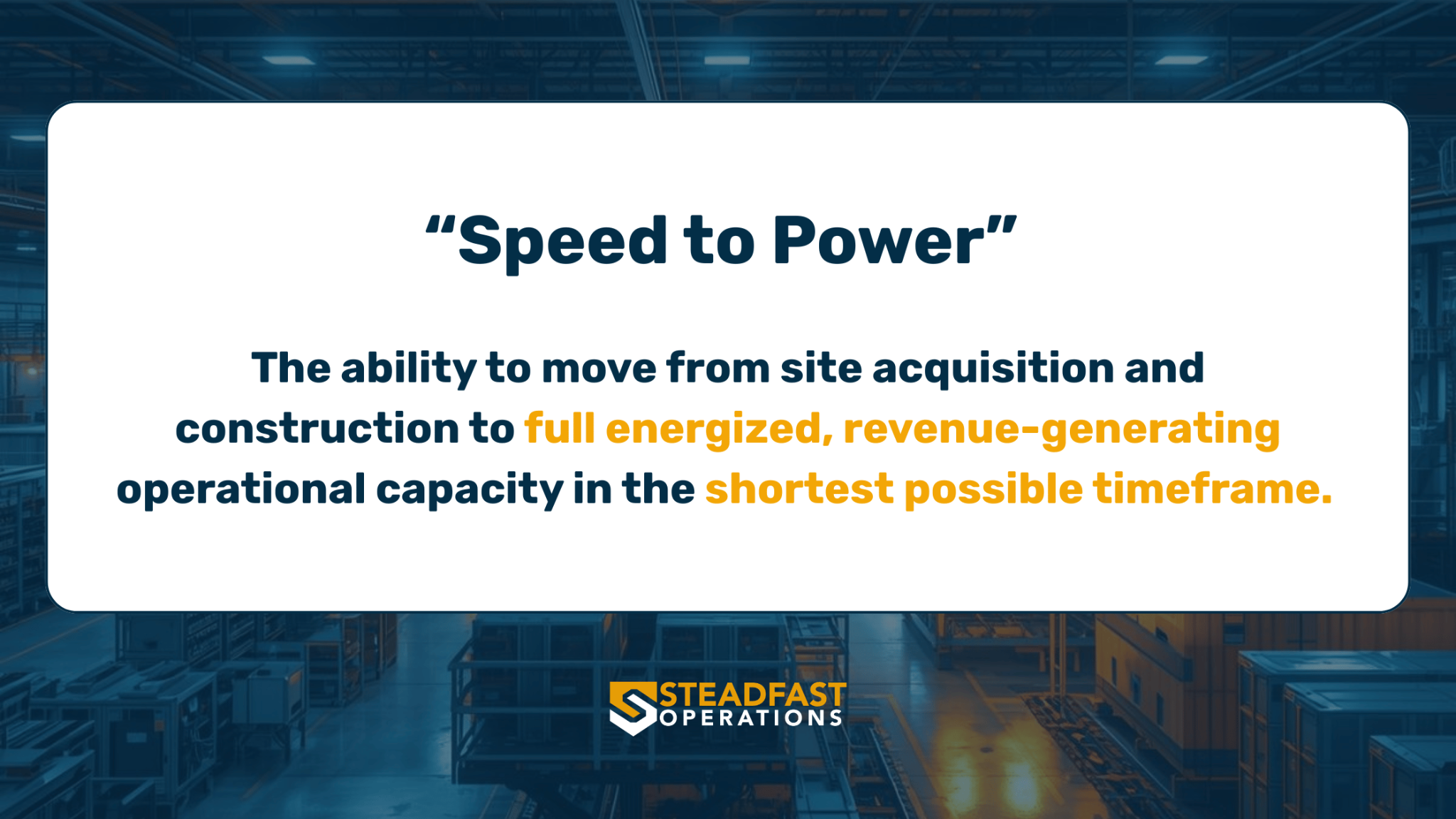
Speed to power refers to the ability to move from site acquisition and construction to fully energized, revenue-generating operational capacity in the shortest possible timeframe.
In AI-driven environments, this process now extends beyond construction milestones. It requires synchronized execution across utility interconnection, commissioning validation, high-density cooling integration, workforce deployment, and early activation of digital work systems such as EAM and CMMS platforms.
Speed is not simply about building faster. It is about achieving operational stability the moment power goes live.
In compressed environments, the margin for error narrows significantly. High-density infrastructure introduces electrical, thermal, and mechanical complexity that magnifies even small execution gaps. When millions of dollars in GPU capacity sit within a single row, performance variability carries measurable financial consequences.
Acceleration must be precise — but it must also be sustainable.
How Has Speed Become a Strategic Differentiator?
AI workloads have intensified infrastructure demand at a scale not seen in the previous decade. Grid capacity constraints are reshaping site selection. Cooling architectures are evolving rapidly. Specialized hardware procurement remains sensitive to global supply fluctuations.
The financial stakes have also shifted. Delays now affect not only schedule but time-to-revenue and competitive positioning. Operators who can energize and stabilize facilities efficiently gain meaningful advantage in customer acquisition and market share.
In response, organizations are investing earlier in engineering precision, procurement collaboration, and supply chain visibility. These disciplines are essential to ensuring infrastructure is delivered on time.
However, infrastructure delivery and operational stability are not interchangeable.
Power can be secured. Equipment can arrive on schedule. Construction can be accelerated.
Operational maturity cannot be retrofitted after turnover.
Where Can Acceleration Quietly Break Down for Data Centers?
In fast-tracked deployments, operational systems frequently trail behind engineering milestones. Digital work platforms may be activated reactively rather than configured in advance. Asset hierarchies may be incomplete at go-live. Preventive maintenance strategies may not yet reflect the realities of high-density load profiles.
Incident response frameworks often exist, but without stress-testing and defined escalation modeling under live conditions, their effectiveness remains theoretical. Workforce expansion may prioritize speed of hiring over depth of expertise, creating strain in precisely the environments that demand technical precision.
The consequences rarely present as immediate catastrophic failure. Instead, instability emerges gradually through increased reactive maintenance, elevated incident frequency, technician fatigue, and unpredictable total cost of ownership.
In many cases, the underlying engineering is sound.
The friction occurs within operational execution.
Speed exposes gaps that slower deployments may have masked.
A Different Starting Point: Operational Readiness in Parallel With Construction
While much of the industry focuses on design optimization and procurement strategy, the most resilient operators begin stabilizing operations long before energization.
At Steadfast Operations, operational readiness is treated as a parallel workstream to construction rather than a post-handoff activity. This approach integrates operational leadership into commissioning and turnover planning from the outset. Digital work management systems are configured and optimized before the first live load. Asset strategies are aligned to density realities rather than theoretical baselines. Incident frameworks are modeled and rehearsed in advance. Workforce capability is developed intentionally, with depth matched to infrastructure complexity.
This alignment ensures that when power is activated, systems, teams, and processes are already operating cohesively.
Acceleration becomes controlled instead of reactive.
Speed becomes sustainable rather than fragile.
The Operators That Win in High-Density AI Environments
Organizations that consistently succeed in compressed deployment cycles share a common trait: they do not separate infrastructure delivery from operational execution.
They align commissioning with operational planning. They activate digital asset management systems early. They validate performance under real load conditions. They model incident response before go-live. They stabilize workforce capability ahead of density scaling.
These disciplines reduce volatility after energization and protect long-term asset performance.
In AI infrastructure, precision matters.
But precision without operational alignment is vulnerable.
The true competitive advantage is not simply speed to power.
It is a stable speed to power.
Before accelerating your next deployment, evaluate whether your operational systems are prepared to support compressed timelines.
Don't let operational challenges slow down your facility. Our team has helped data centers just like yours reduce downtime by 58% and catch problems before they happen.
.png)