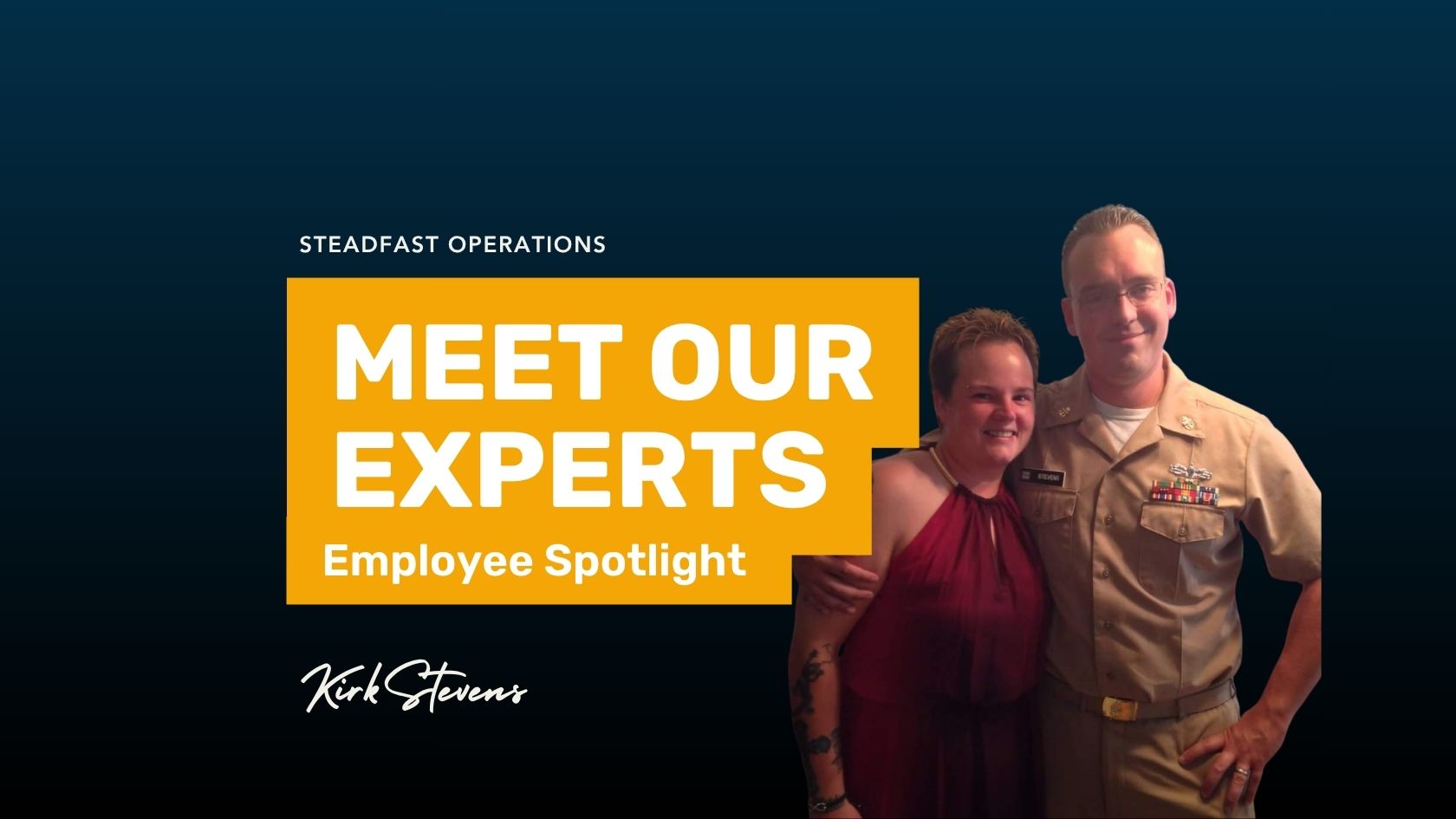
Employee Spotlight: From Nuclear Navy to Mission-Critical Leadership
From Navy nuclear reactors to mission-critical facilities, Kirk Stevens brings 20 years of precision, leadership, and proactive strategy to Steadfast Operations—helping organizations reduce risk and lead with confidence.
In this employee spotlight, Kirk Stevens shares how his 20-year Navy career as a nuclear electrician shaped his approach to operational readiness, proactive maintenance, and leadership. From high-stakes ship commissioning to guiding clients in mission-critical environments, Kirk explains why shifting from reactive to proactive operations is essential for long-term stability. Grounded in honesty, systems thinking, and a people-first mindset, his work at Steadfast Operations helps organizations reduce risk, strengthen infrastructure, and build true Day One Readiness.
Some careers are shaped by opportunity. Others are shaped by responsibility.
For Kirk Stevens, responsibility started early—inside U.S. Navy nuclear reactor plants, where precision was non-negotiable and operational readiness wasn’t a buzzword. It was survival.
A Legacy of Service
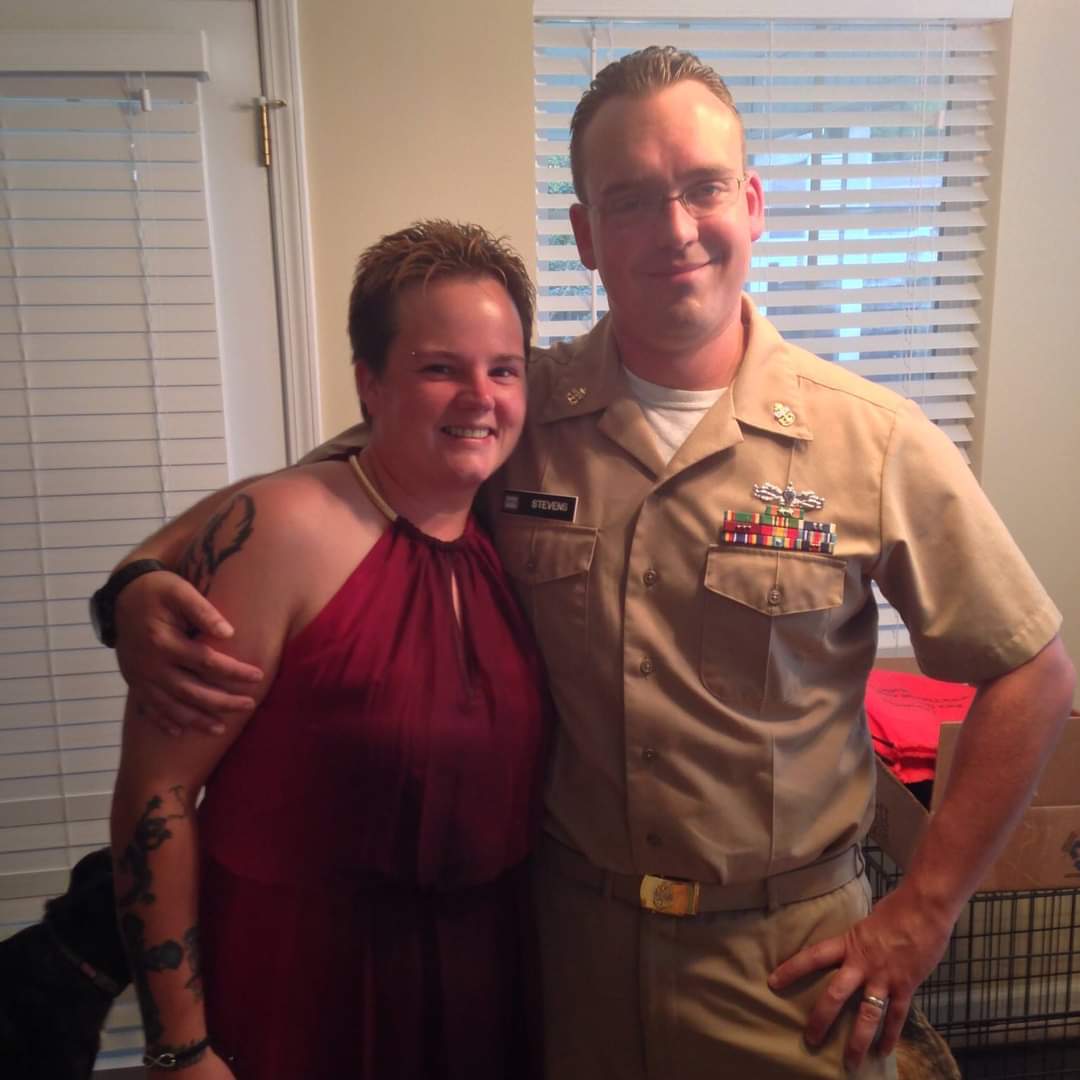
Kirk joined the Navy in 1999 and served for 20 years as a Nuclear Electrician’s Mate before retiring. Service runs deep in his family, with military lineage stretching back to the Civil War and even the Revolutionary War. Stepping into uniform wasn’t just a career decision—it was continuing a legacy.
During his time in the Navy, Kirk completed five aircraft carrier tours, serving in nuclear reactor plants aboard some of the most complex systems in the world. Stationed in Japan, Washington, and Virginia, he experienced firsthand what it means to operate in environments where failure is simply not an option.
But Kirk’s impact extended far beyond technical execution.
Leadership Under Pressure
Within a year of arriving at his first command, Kirk was leading a team of five. That responsibility grew steadily—eventually influencing maintenance planning and operational cadence affecting thousands of personnel across submarine operations in the Atlantic Fleet.
Midway through his career, he took on collateral duty as a 3M Assistant, helping oversee all aspects of maintenance within his department—reviewing cyclic boards, building asset databases, revising preventive maintenance procedures, and running large-scale retrofit and availability windows.
He recalls moments that tested every ounce of discipline and endurance—commissioning ships with zero schedule flexibility and repairing a failed turbine generator for nearly four straight days following 9/11 so operations could proceed safely .
In those moments, readiness wasn’t theoretical. It was immediate. It was personal. It was critical.
From Military Precision to Mission-Critical Environments
When Kirk transitioned out of the Navy, mission-critical infrastructure felt like a natural next step.
Military operations are built on procedure, documentation, accountability, and disciplined execution. That same structure is essential in data centers, healthcare systems, and critical infrastructure environments.
What stood out to Kirk in the private sector, however, was how often organizations operate reactively.
He witnessed companies spend tens or even hundreds of thousands of dollars responding to failures—while resisting investments in structured maintenance programs that would prevent them.
“Being completely reactive is very, very expensive.”
Shifting from reactive to proactive isn’t easy. It requires short-term discomfort and disciplined planning. But without it, organizations remain trapped in a costly cycle of failure response.
What Operational Readiness Really Means
At Steadfast Operations, Kirk defines operational readiness as building the backbone before pressure hits.
It’s about creating infrastructure that allows teams to:
React safely
Respond promptly
Regain control quickly
Reduce the likelihood of catastrophic failure
Failure will happen. The goal is to trend risk down, reduce severity, and control impact.
He often uses a simple analogy: if you take care of your equipment, it takes care of you. Preventive maintenance dramatically lowers the probability of high-risk failures. It doesn’t eliminate risk—but it changes the odds in your favor.
That philosophy extends beyond equipment.
Seeing the System, Not Just the Parts
One of the most common vulnerabilities Kirk sees? Organizations missing the bigger picture.
Teams may maintain individual components but fail to understand how those components connect within critical paths. A switchboard failure can impact entire downstream systems. A rebuilt valve attached to deteriorating piping still presents systemic risk.
Operational risk is not static. It’s a living, evolving variable. Equipment ages. Policies shift. Personnel rotate. Subtle changes compound over time.
Snowflakes aren’t dangerous. An avalanche is.
That’s why Kirk looks several steps ahead—sometimes thousands. When drafting documentation or building programs, he instinctively considers how each element connects to the next, ensuring systems operate as an integrated whole .
Trust Built on Honesty
When asked what clients value most in working with him, Kirk points to two things: honesty and knowledge.
He believes trust begins with listening—understanding the client’s environment before offering solutions. It continues through transparency, even when the answer is, “We need to research that.”
There’s no posturing. No inflated promises. Just grounded expertise built from decades in environments where credibility is earned daily.
People Are the Most Important Asset
Despite the scale and complexity of mission-critical systems, Kirk’s motivation remains human.
He loves working with his team and is driven by the purpose behind the work: preventing incidents, protecting people, and ensuring that everyone goes home safely at the end of the day.
In his view, leadership involvement shows up in operational outcomes. When leaders stay connected to their teams—when they train, invest, and communicate—facilities operate better.
“People are the most important asset of any organization.”
Infrastructure matters. Programs matter. But culture determines execution.
The Steadfast Difference
Kirk Stevens embodies what Steadfast Operations stands for: disciplined planning, proactive execution, and Day One Readiness.
It’s not about avoiding every failure. It’s about building systems and teams that can respond with control and confidence when challenges arise.
From nuclear aircraft carriers to mission-critical facilities, Kirk brings the same mindset to every client engagement:
Prepare deliberately.Maintain relentlessly.Lead honestly.And never leave readiness to chance.
Ready to Put These Ideas into Action?
Don't let operational challenges slow down your facility. Our team has helped data centers just like yours reduce downtime by 58% and catch problems before they happen.
.png)